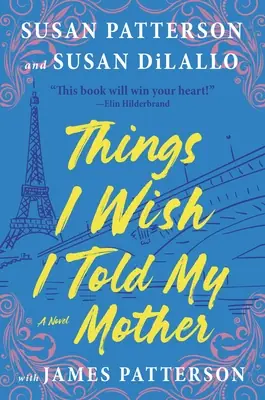
Some books arrive in our lives at the exact moment we need them. Things I Wish I Told My Mother by Susan Patterson and Susan DiLallo is one of those rare novels. I first noticed it in a bookshop when I was wandering without direction, the kind of stroll you take to avoid your own thoughts. The title alone stopped me—because it echoed the ache I had been carrying since my mother’s death two years earlier. What I found inside was not just a story, but an invitation to confront the unspoken truths, unresolved tensions, and hidden love that exist in almost every mother–daughter relationship.
1. Mothers and Daughters Speak in Silences
At the centre of the novel are Laurie, an ambitious advertising executive, and her mother, Liz, a highly respected obstetrician. When they set out on an unexpected trip to Paris, their strained relationship begins to shift. What starts as an obligatory holiday slowly becomes an opening for confessions and long-suppressed emotions.
The book captures how mothers and daughters communicate in ways outsiders rarely understand: a raised eyebrow that carries decades of expectation, a silence that conveys disappointment more clearly than words ever could. Reading their exchanges reminded me how often we assume our loved ones “already know” how we feel, when in truth they may be waiting to hear it said aloud.
2. The Lie of Endless Time
One of the novel’s hardest truths is the reminder that conversations we delay are often conversations lost forever. Laurie continually puts off asking her mother about her childhood, her heartbreaks, her private dreams—believing there will always be another day. Only later does she discover that time is not limitless.
This struck me like a warning bell. We live as though there will always be another evening, another family gathering, another chance to ask the questions we are too hesitant to voice. But mothers, like all of us, are finite. The book makes it clear: we cannot keep postponing the words that matter.
3. The Quiet Legacy of Suppression
Dr Liz embodies the kind of strength many women of her generation were expected to display. She shields her daughter from her own struggles, convinced that silence equals resilience. Yet this very silence teaches Laurie to hide her feelings too.
As the pair navigate Paris, the city becomes a mirror of their relationship—beautiful, exciting, but also unfamiliar and unsettling. Their journey is less about sightseeing and more about daring to share vulnerability. It reminded me how often families express affection through gestures like cooking meals or shopping trips, while leaving fear, grief, or regret unspoken. The novel suggests that breaking this cycle requires courage: one honest question asked in the quiet of a café, one confession made when it feels most awkward.
4. Misunderstood Gifts
Laurie resents her mother’s long absences while pursuing a demanding medical career, interpreting them as neglect. Liz, however, sees her sacrifices as acts of love, proof that she wanted her daughter to grow up independent and capable. This clash of perception will feel familiar to many mothers and daughters.
What the authors do so well is refuse to cast blame. Instead, they show how love can be disguised as criticism, absence, or practicality. In my own life, I remembered how I once rolled my eyes at my mother’s insistence on sending money “just in case” or her nagging reminders about routine health checks. With time, I realised these were her imperfect but deeply sincere ways of saying: I care for you more than anything.
5. Conversations Beyond Death
Perhaps the most powerful part of the story is its recognition that dialogue does not end with death. After her mother’s passing, Laurie uncovers fragments of a hidden life: journal entries, receipts, stories told by others. Through these, she continues her conversation with Liz, though now in a different form.
This idea resonated with me profoundly. I thought of my own mother’s recipe cards, where her notes about spices and substitutions reveal as much about her personality as any conversation we had. The novel encourages us to honour our mothers not only by remembering them but also by daring to ask questions while they are still alive.
A Book That Changes How You Listen
Things I Wish I Told My Mother is a moving reminder that relationships are fragile, and silence can wound as deeply as harsh words. It urges us to look again at the women who raised us—not only as mothers, but as complex individuals with their own joys, sorrows, and untold stories.
You should read this book if you have ever felt misunderstood by your mother, or if you carry unspoken words that weigh on your heart. You should read it if you need encouragement to reach out, to ask the awkward questions, or to simply say, “I love you,” while there is still time.
Above all, you should read it because it shows that love endures—even when imperfect, even when belated, even when spoken too softly.