In the annals of art history, few narratives are as captivating as the cross-pollination of cultures along ancient trade routes, where ideas flowed as freely as silk and spices. “Studies in Chinese Art and Some Indian Influences,” a slim yet scholarly volume emerging from the intellectual ferment of the 1930s, captures this interplay with admirable clarity. Published by the India Society in London, the book distils four lectures delivered in tandem with the landmark International Exhibition of Chinese Art at the Royal Academy in 1935-36—an event that drew global attention to Asia’s artistic treasures amid the gathering shadows of world conflict. This was a time when Western academia, buoyed by archaeological breakthroughs in Central Asia and China, sought to map the diffusion of Buddhist iconography from India eastward, challenging the insularity of European art histories. The exhibition itself, showcasing thousands of artefacts loaned from across empires past and present, reflected a broader interwar curiosity about the Orient, even as colonial powers grappled with their waning grip on Asia.
|
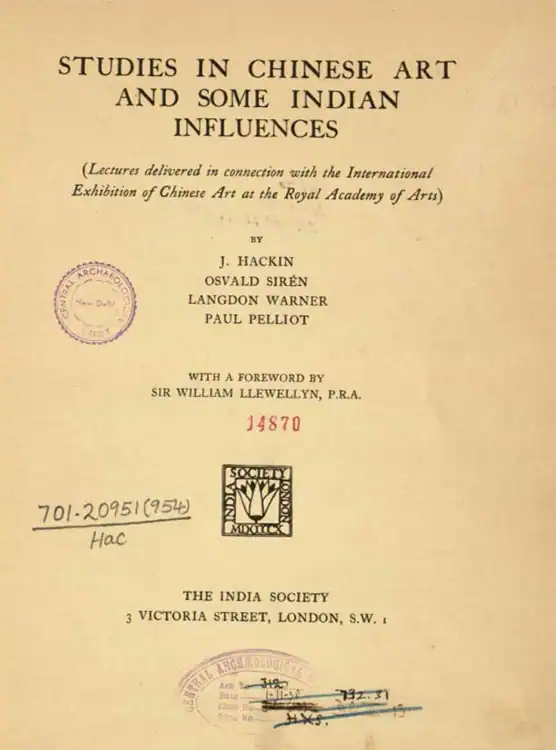
Book Info Studies in Chinese Art and Some Indian Influences
– Lectures delivered in connection with the International Exhibition of Chinese Art at the Royal Academy of Arts
By J. Hackin, Osvald Sirén, Langdon Warner and Paul Pelliot
With a foreword by Sir William Llewellyn, P.R.A.
Published by The India Society, London – 1938
Download book: https://bit.ly/47EjIuT
Alternate book download link: https://archive.org/download/in.gov.ignca.14870/14870.pdf
|
The historical backdrop is richly layered: the lectures trace Buddhist art’s journey from the Kushan Empire under Kanishka in the first centuries AD, through the Sasanian and Gupta influences, to its sinicisation in Tang-era China. This era saw pilgrims and traders traverse treacherous passes, carrying not just scriptures but stylistic motifs that blended Hellenistic realism with Indian spirituality and Iranian grandeur. Sites like Bamiyan in Afghanistan, with its colossal Buddhas hewn from cliffs (tragically lost in later times), and the cave temples of Turfan and Yungang, serve as waypoints in this odyssey. The book underscores how geopolitical shifts—Muslim incursions, nomadic migrations, and the rise of Chinese dynasties—shaped artistic evolution, turning isolated oases into crucibles of fusion. Yet it also nods to the modern rediscovery of these relics, crediting early 20th-century expeditions that unearthed treasures amid the sands, often under the aegis of European institutions.
A respectful scrutiny reveals subtle undercurrents of colonial bias, though none overt or inflammatory. The authors, all Western scholars, frame their analyses through a lens of comparative art history that prioritises European methodologies—classifying styles by dynasty and influence in a manner reminiscent of classical archaeology. There is an implicit assumption that these “Oriental” arts gain legitimacy through parallels with Greco-Roman traditions, as seen in references to Hellenistic echoes in Bamiyan. Derogatory tones are absent; instead, the text celebrates the sophistication of Asian craftsmanship, perhaps as a counter to prevailing stereotypes. However, the reliance on Western-led excavations—such as those by French teams in Afghanistan or Swedish efforts in China—hints at an era when colonial access facilitated scholarship, sometimes at the expense of local stewardship. No justifications for imperialism appear, but the narrative occasionally romanticises the “discovery” of ancient sites, glossing over the power dynamics that enabled such endeavours.
A chilling archaeological note from Anyang’s tombs: “Many of these were beheaded, and we know of cases where people had been buried in groups of ten—that is to say, ten in each tomb, with another tomb alongside it for their ten heads.”
The quartet of authors brings a wealth of expertise, each a luminary in the nascent field of Asian art studies. Joseph Hackin, director of Paris’s Musée Guimet, lends archaeological rigour to his survey of Central Asian Buddhist art, drawing on firsthand explorations of remote sites. Osvald Sirén, curator at Stockholm’s National Museum, offers a nuanced take on sculptural influences, his Swedish perspective infusing a cool analytical detachment. Langdon Warner, an American Harvard-affiliated explorer known for his Central Asian ventures, advocates a holistic approach to sculpture, emphasising technique and intent over mere chronology. Finally, Paul Pelliot, the French sinologist famed for his Dunhuang manuscript hauls, delves into the royal tombs of Anyang, blending philology with archaeology to illuminate Shang dynasty bronzes. Together, they embody the internationalist spirit of pre-war scholarship, their collaborative effort a testament to how art transcends borders.
Amid the erudition, several snippets stand out for their vivid insight. One evokes the technical marvel of ancient bronze casting: “Before this thing could stand in bronze the craftsman modelled his clay to the shape of the inside surfaces. Then he overlaid the lump with thick wax, modelled into the surfaces we see.” Another reflects on cultural humility: “The only hardship we Westerners must face when we try to get full value from the rich storehouse of Far Eastern sculpture is the wrench that inevitably comes when prejudice is to be lopped off.”
A chilling archaeological note from Anyang’s tombs: “Many of these were beheaded, and we know of cases where people had been buried in groups of ten—that is to say, ten in each tomb, with another tomb alongside it for their ten heads.” On artistic purpose: “In all soberness it is my belief that beauty lies within the object, not in the beholder; and that mere appreciation of externals—however lovely—can never satisfy.” And a nod to early Buddhist zeal: “At Yung Kang, their first capital inside the Great Wall, these converts cut deep chapels in the stone cliffs and embellished them with figures—the earliest Buddhist stone-carvings we know in China.”
This volume, though dated in its scope, remains a thoughtful bridge between East and West, reminding us that art’s true value lies in its capacity to connect disparate worlds. In an age of renewed interest in Silk Road heritage, it offers enduring lessons on cultural exchange—respectfully rendered, if imperfectly impartial.
Courtesy: Rare Book Society of India.