For decades, air superiority conjured up a familiar image — sleek fighter jets slicing through clouds, their roar symbolising speed, precision, and national pride. Power in the skies used to mean who had the most advanced aircraft or the longest-range missiles. But recent conflicts, especially in Ukraine, have revealed a different story. The old symbols of might are giving way to something smaller, cheaper, and far more networked. The best air defence systems in the world are adopting these emerging air defence technologies and changing the rules of the game.
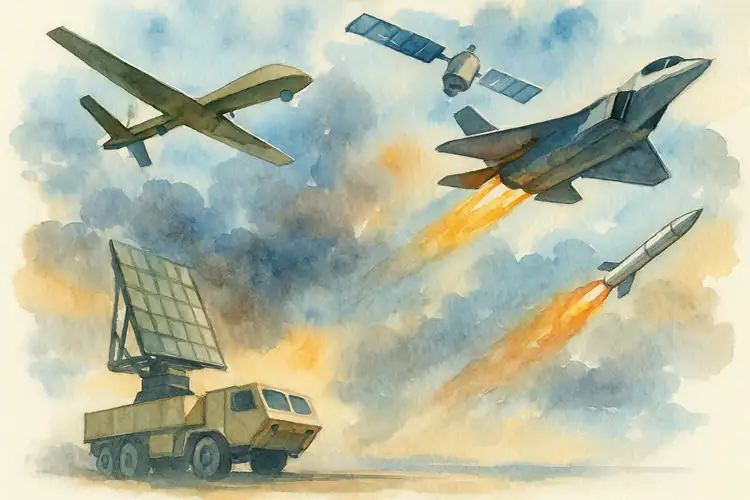
Air defence is no longer just about planes and missiles — it’s about data, satellites, and algorithms. The new battles are fought across a digital and physical web where drones, AI, and even civilian technology work together. The outcome of a conflict can depend as much on code as on courage. In this new era, the question isn’t who flies higher, but who thinks faster.
The Drone Revolution: Beyond Remote Control
Drones — or Uncrewed Aerial Vehicles (UAVs) — have completely redrawn the map of modern warfare. What began as reconnaissance tools are now central offensive assets. Their success lies not only in their firepower but in how seamlessly they connect with satellites and AI-driven systems.
Take the Turkish Bayraktar TB2, for instance. It’s not just a machine — it’s a symbol of affordability and accessibility in modern conflict. The TB2 proved its worth in Libya, Syria, Nagorno-Karabakh, and Ukraine, giving even modest militaries a precision-strike capability once reserved for superpowers.
Russia’s approach in Ukraine further underlines this shift. Its swarms of one-way attack drones — cheap, destructive, and relentless — have turned the sky into a low-cost battlefield. What’s revolutionary here isn’t just technology, but economics: drones have democratised air power. The ability to contest the air is no longer the privilege of the few.
The Ghost in the Machine: AI Behind the Scenes
AI in warfare isn’t just about killer robots or autonomous swarms — that’s the Hollywood version. The real transformation is subtler and far more pervasive. Artificial intelligence now powers the decision-making engines of war.
As the Stockholm International Peace Research Institute notes, military AI has shifted focus from autonomy to cognition — from “acting” to “thinking.” Today’s systems assist in processing the endless data streams pouring in from drones, satellites, and sensors. They don’t replace humans but amplify them — speeding up analysis, identifying patterns, and helping commanders make decisions in seconds rather than hours.
And it’s not just the old defence giants building this future. Start-ups — agile, software-driven, and often self-funded — are reshaping the defence industry. Their edge lies in rapid iteration, not bureaucracy. Increasingly, it’s the quality of the algorithm, not the price of the aircraft, that determines who wins.
The New High Ground: Space and Cyber
Air defence now stretches far beyond the atmosphere. The true “high ground” isn’t altitude — it’s orbit. Satellites guide missiles, track troop movements, and enable communication. When those satellites are disrupted, entire command structures can falter.
The Ukraine war made this dependence painfully clear. SpaceX’s Starlink kept Ukrainian communications alive when other systems went dark. Companies like Planet Labs provided real-time satellite imagery that reshaped battlefield intelligence. Yet this reliance brings a new vulnerability: private corporations — not governments — now control many of these crucial systems. In war, that’s both an asset and a liability.
To counter that, militaries are developing “counterspace” and cyber capabilities. The first strike in the next major conflict may not come from a missile but from a burst of invisible code, severing links and blinding networks before the first explosion is heard.
Faster Than a Bullet: The New Arms Race
Offence evolves fast — and defence must race to catch up. Europe, in particular, is experiencing what analysts call a “missile renaissance.” New systems are being tested, stockpiled, and deployed at an unprecedented pace.
When Russia tested its new Oreshnik intermediate-range missile in late 2024, it reignited fears of an arms race. But as the SIPRI Yearbook 2025 warns, this isn’t a replay of the Cold War. It’s messier. Today’s arms race mixes hypersonic missiles, AI-guided systems, and dual-use technologies that blur the line between conventional and nuclear. The battlefield is not just more dangerous — it’s more unpredictable.
The Garage Innovators: Civilian Tech Goes to War
Perhaps the most striking change in air defence is where innovation now comes from. Once, cutting-edge technology emerged from secretive government labs. Now, it often starts in someone’s garage or a Silicon Valley startup.
The term Military-Civil Fusion captures this phenomenon. Civilian innovations — from drone designs to AI chips — are being adapted for combat at lightning speed. In Ukraine, civilians repurposed DJI drones into deadly FPV weapons. Apps built by volunteers are helping coordinate strikes and share live intelligence. Meanwhile, tech behemoths like Google and Amazon hold the keys to AI, cloud computing, and satellite networking — technologies that underpin modern defence.
It’s an uneasy reality: innovation is faster, but control is looser. Smaller nations and even non-state actors can access tools that once required a defence budget. At the same time, the dominance of Big Tech risks widening the gap between major powers and everyone else.
Conclusion: New Air Defence Technologies
Air defence is no longer about who rules the sky — it’s about who commands the network. The fusion of drones, AI, space assets, and civilian ingenuity is rewriting the rules of war.
But with opportunity comes uncertainty. The line between civilian and military technology has blurred beyond recognition, raising questions of accountability and control. In this new reality, power doesn’t just lie with states or armies. It lies with coders, entrepreneurs, and private companies whose innovations shape the tools of conflict.
The next great contest for security may not unfold between nations, but between those who build technology — and those who depend on it.