In 2024, the world spent more on weapons than at any other point in recorded history. For the tenth consecutive year, global military expenditure climbed—this time breaching the almost surreal figure of $2.7 trillion. It’s a number so vast it barely feels real, yet its effects are painfully tangible. Those trillions bankroll the wars filling our newsfeeds: the grinding, mechanised horror in Ukraine and the unrelenting devastation in Gaza. This surge in spending didn’t appear out of thin air. It reflects something deeper—a world that feels increasingly insecure, where diplomacy stumbles and the instinct to rearm takes over. Nations are racing to refill depleted stockpiles, ordering artillery shells by the million and fighter jets by the dozen, while pouring billions into AI-driven defence systems that promise speed but also uncertainty. The so-called peace dividend that briefly flickered after the Cold War seems now like a quaint myth. And so one question naturally arises: who are the companies fuelling this massive rearmament? Who are the top 10 biggest arms producers in the world in 2025?
The Top 10 Biggest Arms Producing Companies
To understand this world, let’s count down the ten biggest arms producers, ranked by their 2023 revenues. Together, they map the industrial heart of modern warfare—where technology, power, and profit converge.
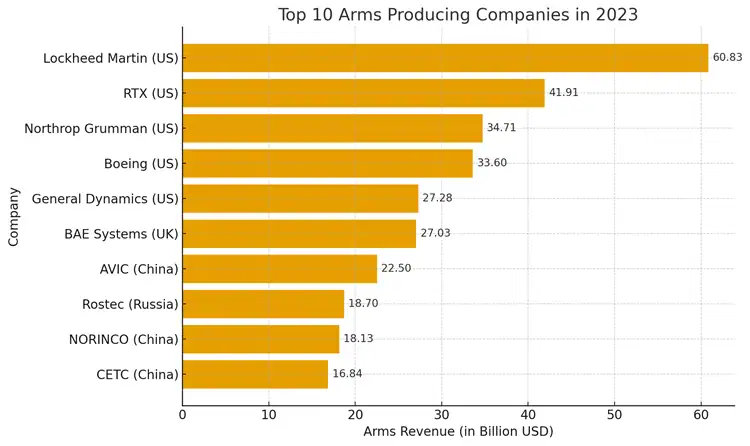
10. CETC (China) — $16.84 Billion
China Electronics Technology Group Corporation—CETC—might not make tanks or jets, but its reach is everywhere. Its specialty is the invisible layer of war: radars, jammers, sensors, satellites. Modern combat depends as much on who sees first as who shoots first, and in that sense CETC represents the new frontline. Its rise in the top ten is a reminder that the next great arms race may not be about bombs, but about bandwidth.
9. NORINCO (China) — $18.13 Billion
NORINCO, or China North Industries Group, builds the hard stuff—guns, tanks, and rockets. It’s the muscle behind the People’s Liberation Army’s ground forces and a major exporter to Africa, the Middle East, and Southeast Asia. Some of its products—like the VT-4 main battle tank—are now regulars at international defence expos. It’s the kind of company that quietly reshapes the global arms market, one export deal at a time.
8. Rostec (Russia) — $18.70 Billion
Rostec is Russia’s defence empire-in-miniature, overseeing hundreds of firms that together build almost everything the Russian military uses. Since the 2022 invasion of Ukraine, sanctions have strangled its export market, forcing it to focus almost entirely on supplying its own war effort. Its place in the top ten, therefore, says less about international success and more about how war economies can sustain themselves, at least temporarily, on domestic demand.
7. AVIC (China) — $22.50 Billion
AVIC, the Aviation Industry Corporation of China, manufactures fighter jets, helicopters, and transport aircraft. Its inclusion here—alongside NORINCO and CETC—illustrates how China’s defence industry has matured into a comprehensive ecosystem. What began as imitation now looks like independence. The country’s decades-long push for technological self-reliance appears to be paying off, although some analysts question whether its cutting-edge projects truly rival Western equivalents or merely match them on paper.
6. BAE Systems (United Kingdom) — $27.03 Billion
Europe’s largest arms producer, BAE Systems, is quietly booming. Headquartered in the UK, it builds everything from submarines to Typhoon fighter jets. The war in Ukraine has been good for business—an uncomfortable truth that BAE shares with nearly every Western contractor. In the past two years, it’s seen record orders from European governments scrambling to rebuild defences neglected since the 1990s. The irony isn’t lost on observers: peace in Europe once meant disarmament; now it means spending.
5. General Dynamics (United States) — $27.28 Billion
General Dynamics is an old name in the American defence lexicon. Its tanks—the M1 Abrams—have become almost mythic symbols of U.S. military might. Yet its real strength lies in its diversity: submarines, armoured vehicles, IT systems. It’s the kind of company that thrives in long wars and stable budgets alike, its fortunes tied not to ideology but to contracts.
4. Boeing (United States) — $33.60 Billion
Most people know Boeing for its commercial jets, but the company’s defence arm remains enormous. From F/A-18 fighters to Apache helicopters, it produces the aircraft that fill hangars across NATO. In recent years, Boeing’s civilian woes—grounded planes, corporate scandals—have drawn attention, but the defence side keeps humming along, buoyed by Pentagon money and export deals. It’s a reminder that even troubled giants can still dominate when the state remains their biggest customer.
3. Northrop Grumman (United States) — $34.71 Billion
Northrop Grumman sits at the frontier of military technology. Its engineers build stealth bombers, drones, and space systems that rarely make headlines but quietly define the next era of warfare. The forthcoming B-21 Raider, for instance, may eventually replace the aging B-2 Spirit—a plane designed before many of its current engineers were born. Whether this represents progress or an endless cycle of escalation is, perhaps, a question for another essay.
2. RTX (United States) — $41.91 Billion
You may still know it by its old name, Raytheon. RTX is the world’s undisputed leader in missile technology. Its Patriot air defence system, once a Cold War relic, has suddenly become indispensable again, shielding cities from missile and drone attacks in Ukraine and Israel. By the end of 2024, RTX had a jaw-dropping $218 billion in backorders—proof that in a frightened world, there’s always demand for a better shield.
1. Lockheed Martin (United States) — $60.83 Billion
Lockheed Martin towers over them all. With revenues surpassing $60 billion, it’s less a company and more an institution—one whose products, like the F-35 Lightning II, have become the defining symbols of Western military power. To some, Lockheed represents the pinnacle of engineering; to others, the industrial embodiment of endless war. Its backlog alone—$176 billion worth of orders—could fund a small nation. Whatever your view, it’s clear that Lockheed Martin doesn’t just build weapons; it builds the infrastructure of deterrence itself.
The Bigger Picture: The Forces Shaping the Market
American Supremacy
The numbers tell their own story. Of the world’s top five arms companies, all are American. Together, they earned nearly $200 billion from weapons sales in 2023. Expand that to the top hundred, and U.S. firms still take more than half of the world’s total defence revenue. It tops the list of the largest arms exporters in the world. That kind of economic weight translates easily into geopolitical influence. America’s share of global arms exports—43% in recent years—ensures its weapons, its standards, and, to an extent, its politics travel further than any other nation’s. Whether that’s stabilising or dangerous depends on who you ask.
China’s Determined Rise
Across the Pacific, China’s story feels like a mirror image. Nine Chinese firms made the top hundred, capturing 16% of total sales. Beijing’s approach is unmistakably strategic: state-driven investment, long-term industrial planning, and an ambition not just to arm itself but to export power through hardware. Countries like Pakistan, Myanmar, and Nigeria have already become reliable buyers. Yet there’s a subtle difference—China’s exports may be expanding, but trust in its technology and transparency remains uneven. In global arms deals, reliability often counts more than price.
The Shadow of War
If one event shaped the current arms market, it’s the war in Ukraine. The conflict has functioned like a live-fire advertisement for Western weaponry. Javelins, HIMARS, and Patriots have turned into household names. As a result, Western firms can barely keep up with demand, while Russia’s export market has all but collapsed under sanctions and battlefield losses. The vacuum left by Russia’s decline is already being filled by the U.S. and China—each vying for influence in the arms-hungry states of Africa, the Middle East, and Southeast Asia.
The Unseen Battlefield: Corruption and Complicity
Behind the statistics lies a more uncomfortable truth. The arms trade has always been shadowed by corruption, secrecy, and moral ambiguity. It’s an industry where billion-dollar deals are often signed behind closed doors, where bribes can masquerade as “consultancy fees,” and where accountability tends to disappear into classified budgets.
A 2024 Global Financial Integrity report bluntly states that “corruption in the arms trade is never victimless.” That might sound like a slogan, but anyone who’s seen how weapons end up in the wrong hands knows it isn’t. Every illicit payment means fewer hospitals, fewer schools, and sometimes—tragically—more graves.
At the same time, many arms companies now face a strange paradox: even as profits soar, financing gets harder. Banks and pension funds increasingly avoid the sector under so-called ESG (Environmental, Social, and Governance) policies. It’s an awkward irony—war drives the demand, but peacetime ethics constrain the supply of money. Still, few investors can resist the returns that come from perpetual insecurity.
Conclusion: Big Arms Supplier Companies
The arms industry today feels both unstoppable and unstable. American companies dominate, China is catching up fast, and Russia has turned inward to feed its own war machine. The industry’s growth is powered less by ideology than by fear—fear of the next invasion, the next missile strike, the next failure of deterrence.
But the future may not belong to these giants forever. As drones, artificial intelligence, and low-cost autonomous systems reshape the battlefield, smaller firms and even civilian tech companies could start to outpace the traditional defence titans. Whether Lockheed or RTX can adapt to that faster, cheaper, data-driven future remains to be seen.
What seems certain, though, is that the $2.7 trillion we spend on arms tells us something unsettling about our world. We appear to believe that safety can be bought—and that belief, as history has shown, is both comforting and dangerous.