
As of 2025, Russia’s Avangard hypersonic glide vehicle remains the fastest operational missile known to exist—reportedly capable of hitting speeds of up to Mach 27 (around 32,200 km/h). That figure sounds almost absurd until you realise it can cover the distance from Moscow to London in about ten minutes. Not far behind are China’s DF-41 and Russia’s RS-28 Sarmat, both of which sit comfortably in the club of the 5 fastest missiles in the world.
Why does speed matter for missiles?
What makes the fastest missiles in the world so significant isn’t just raw speed, though that certainly plays a part. Speed gives them an eerie kind of advantage: it compresses reaction time to mere seconds, making interception almost impossible. The faster a missile moves, the less chance an opposing system has to even see it. Let alone stop it. Yet speed also brings practical benefits. It can extend range, reduce flight time, and allow for almost instantaneous retaliation. Some analysts suggest this makes hypersonic systems less about deterrence and more about dominance, though that view isn’t universally accepted.
When people talk about “Mach numbers,” they’re describing how many times faster an object travels than sound. Measuring that isn’t simple guesswork—during missile tests, radar tracking, satellite telemetry, and onboard sensors all work together to pin down velocity, trajectory, and flight performance with near-manic precision. Of course, the figures released publicly may only tell part of the story; in this field, secrecy moves just as fast as the missiles themselves.
List of the 5 fastest missiles in the world
The 5 fastest missiles in the world are Avangard, DF-41, Trident 2, Minuteman 3, and RS-28 Sarmat.
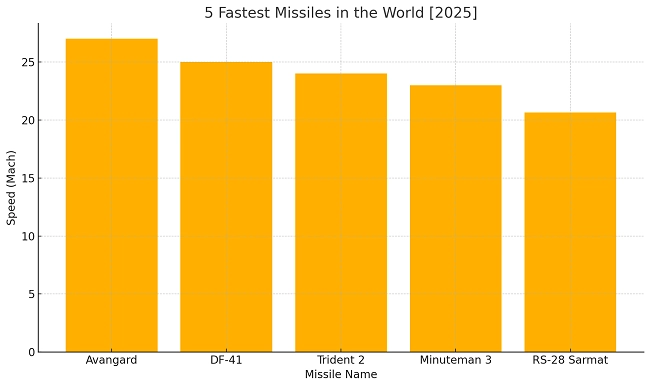
*1 Mach ≈ 1,234.8 km/h (at sea level)
1. Avangard, world’s fastest missile
Watch the Russian MoD video of the Avangard
The Avangard missile has earned its reputation as a game-changer in hypersonic technology. Developed by Russia, the Avangard is capable of reaching speeds up to Mach 27, or 32,200 kilometers per hour. During a speech in March 2018, Russian President Vladimir Putin described it as one of the six “next generation” weapons.
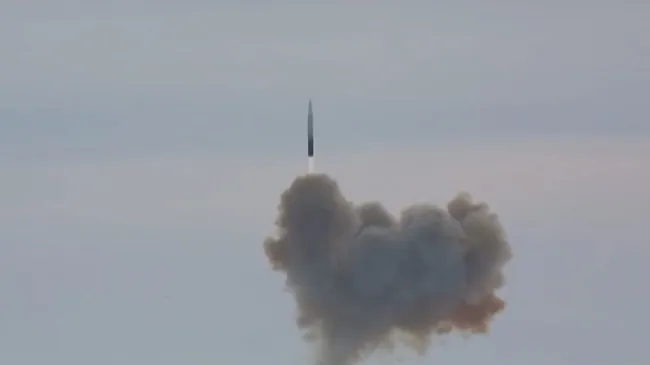
It is a Hypersonic Glide Vehicle (HGV)-class missile. Unlike traditional ballistic missiles, which follow a predictable arc, HGVs can manoeuvre mid-flight, making them harder to detect, track, and intercept. This combination of speed and agility gives HGV-equipped missiles a major strategic advantage in modern warfare. In 2019, Russia installed its first Avangard-equipped missile.
Key features
Origin- Russia
Alternative name: Project 4202, Yu-74
Class: HGV. On November 21, 2024, Ukraine experienced the devastation of Russia’s Mach 10 Oreshnik Missile, which is also a HGV class missile.
Speed: Capable of reaching speeds between Mach 20 and Mach 27 (approximately 24,000–32,200 km/h or 15,000–20,000 mph). It is able to cover vast distances in minutes (e.g., Kashmir to Kanyakumari, ~3,400 km, in 5–6 minutes).
Range: Exceeds 6,000 km (3,728 miles), with some estimates suggesting up to 10,000 km when mounted on certain intercontinental ballistic missiles (ICBMs).
Warhead: Can carry nuclear (up to 2 megatons, equivalent to ~130 Hiroshima bombs) or conventional warheads. Its kinetic energy alone at Mach 20–27 is equivalent to 21 tons of TNT, capable of destroying smaller targets without an explosive payload.
Launch Platform: Deployed as a multiple independently targetable reentry vehicle (MIRV) atop ICBMs, including:
- SS-19 Stiletto (UR-100NUTTH): Current carrier.
- RS-28 Sarmat (Satan II): Planned replacement for enhanced range and payload capacity.
Initially intended for the RS-26 Rubezh, but financial constraints shifted focus to the Sarmat
Status: In service
Maneuverability: Performs sharp horizontal and vertical evasive maneuvers during its glide phase, making it nearly impossible to intercept with current missile defense systems.
2. DF-41: China’s Swift Strategic Deterrent
China’s Dongfeng-41 (DF-41) is a ballistic missile that has captured the attention of military analysts worldwide. With a reported top speed of Mach 25, or approximately 30,600 kilometers per hour, the DF-41 is among the fastest missiles in China’s arsenal.
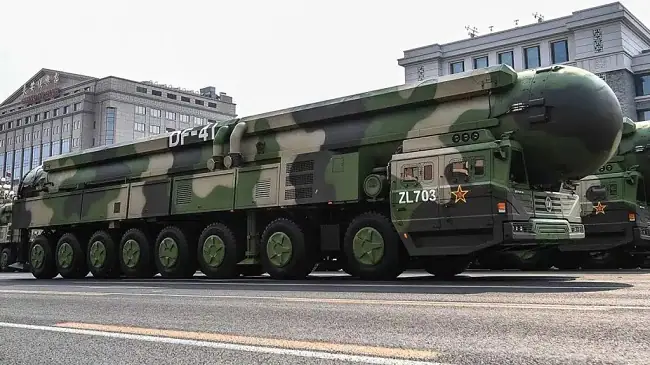
Its impressive range and ability to carry multiple warheads make it a formidable strategic deterrent.
Key features
Origin- China
Alternative names: Dong Feng-41, CSS-X-20
Class: Intercontinental Ballistic Missile (ICBM)
Length: 20-22m
Payload: 2,500 kg
Warhead: up to 10 nuclear warheads, MIRV
Range: 12,000-15,000 km
Status: In service
3. Trident 2: Unmatched Submarine-launched Precision
The Trident 2, an integral part of the United States’ naval defense, is a submarine-launched ballistic missile renowned for its exceptional speed and accuracy.
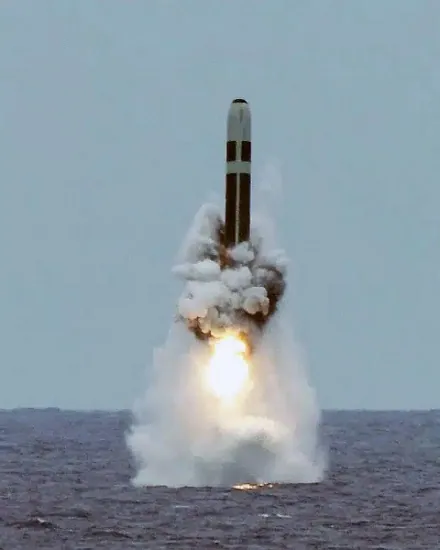
Capable of reaching speeds exceeding Mach 24, or around 29,654 kilometers per hour, the Trident 2 serves as a key component of the U.S. Navy’s sea-based nuclear deterrent.
Key features
Origin- United States
Class: Submarine Launched Ballistic Missile (SLBM)
Length: 13.42
Payload: 2,800 kg
Warhead: Up to 8 MIRV Mk 4 or Mk 5 warheads
Range: Minimum 2,000 km, Maximum 12,000 km
Status: In service (1990-present)
4. Minuteman 3: America’s Intercontinental Ballistic Missile
The Minuteman 3, another stalwart of the United States’ ballistic missile arsenal, boasts impressive speed and range.
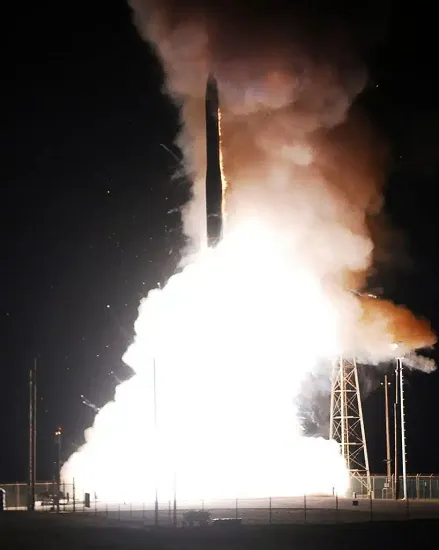
With a maximum speed of approximately Mach 23, or 28,200 kilometers per hour, the Minuteman 3 serves as a crucial element of America’s intercontinental ballistic missile (ICBM) capabilities, providing rapid and precise response capabilities.
Key features
Origin- United States
Class: Intercontinental Ballistic Missile (ICBM)
Length: 18.2m
Payload: Up to 3 Mk 12A; 1 Mk 21 RV with penetration aids
Warhead: W78 at 335 kT, W87 at 300 kT nuclear
Range: 13,000 km
Status: Operational
5. RS-28 Sarmat, 5th fastest missile in the world
Watch the Russian MoD video of the RS-28 Sarmat
The RS-28 Sarmat, often referred to as “Satan 2,” is a heavyweight among hypersonic missiles developed by Russia. While its exact speed is classified, estimates suggest it surpasses Mach 20.4, or 25,500 kilometers per hour.

Designed to carry a variety of warheads and penetrate any existing or prospective missile defense systems, the RS-28 Sarmat represents a formidable advancement in Russia’s military capabilities. With a maximum range of up to 18,000km, RS-28 Sarmat is the longest range missile in the world.
Key features
Origin- Russia
Class: Intercontinental Ballistic Missile (ICBM)
Length: 35.3m
Payload: 10,000 kg
Warhead: Nuclear, MIRV or glide vehicles
Range: 10,000-18,000 km
Status: Operational
Summary of the 5 fastest missiles in the world
The 5 fastest missiles in the world in 2024 are
1. Avangard – Mach 27 ( 32,200 km/h)
2. DF-41- Mach 25 (30,600 km/h)
3. Trident 2- Mach 24 ( 29,654 km/h)
4. Minuteman 3 – Mach 23 (28,200 km/h)
5. RS-28 Sarmat – Mach 20.64 ( 25,500 km/h)
It’s tempting to end on a dramatic note—the idea that missiles like Avangard, DF-41, Trident II, Minuteman III, and RS-28 Sarmat mark the dawn of a new military age. And perhaps they do. Each represents a different expression of the same obsession: to move faster, strike farther, and stay untouchable. Yet, for all their technological brilliance, they also remind us how fragile the balance of power has become. The faster these weapons get, the shorter the world’s reaction time—and the thinner the line between deterrence and disaster.
FAQs: World’s fastest missiles
What is China’s fastest missile?
Ans: Dongfeng-41 (DF-41) is China’s fastest missile. It’s maximum speed is Mach 25, or approximately 30,600 kilometers per hour.
What’s the fastest missile in the world?
Ans: Russia’s Avangard is the fastest missile in the world. This hypersonic missile is capable of reaching speeds up to Mach 27, or 32,200 kilometers per hour.
What is the top speed of a hypersonic missile?
Ans: Hypersonic missiles, by definition, travel faster than Mach 5—over 6,100 km/h or 3,800 mph. That sounds abstract until you realise it’s roughly five times faster than a bullet leaving a rifle. Among these, Russia’s Avangard is still believed to be the fastest, reportedly touching Mach 27—about 32,200 km/h. Others, such as China’s DF-41 and Russia’s Sarmat, hover somewhere between Mach 20 and Mach 25, while most hypersonic cruise missiles—like Zircon—top out around Mach 9. Even at the lower end of that range, you’re talking about crossing the Atlantic in under an hour.
Which country has the best hypersonic missile?
Ans: At present, Russia, China, and the United States dominate the race for hypersonic supremacy. Russia appears to hold the edge, at least for now, with the Avangard glide vehicle and Zircon cruise missile often cited as combat-ready. Both are known for extreme velocity and unpredictable flight paths, which makes them incredibly difficult to intercept. China, for its part, has moved fast—its DF-ZF and DF-17 systems demonstrate remarkable precision and agility. The United States, though slower to deploy, is catching up quickly, with the Long-Range Hypersonic Weapon (LRHW) expected to become operational soon.
Sources
- “What is the Fastest Missile in the World and How Much Does Speed Really Matter?” sputnikglobe.com. Accessed 18 Nov. 2023.
- “DF-41 (Dong Feng-41 / CSS-X-20).” missilethreat.csis.org. Accessed 18 Nov. 2023.






You missed Agni V in your list
Yes Agni easily surpasses RS-28 Sarmat
Seems someone forgot to mention the SS-22N sunburn anti-ship missile