Europe has been through a lot of ups and downs in the last fifteen years, including the Eurozone debt crisis, the Covid-19 pandemic, and the ongoing war in Ukraine. But even with all these problems, a new economic geography is starting to take shape. Some countries and cities have shown amazing strength and have become the driving force behind Europe’s recovery after the crisis. By 2025, the fastest-growing economies on the continent are a surprising mix of traditional powerhouses, smaller innovators, and fast-growing Eastern European catch-ups. Today, the story of growth in Europe is not one of steady growth, but of different speeds and changing centres of gravity.
The EU Countries with the Most GDP Growth in 2025
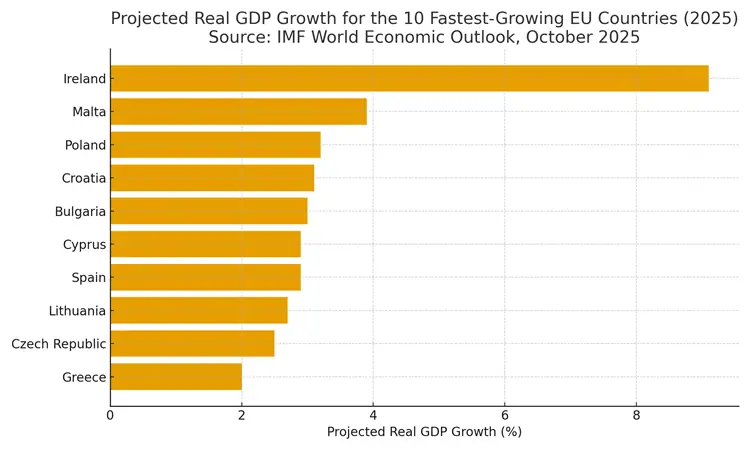
Eurostat’s Q2 2025 GDP data, which came out on July 30, showed that the average GDP growth in the European Union was 1.5 percent. Only a few member states were able to beat that number.
When looking at nominal GDP, Western Europe is still in the lead. The economy of Germany alone is expected to reach $4.7 trillion by 2025. The economies of all of Western Europe together are expected to produce about $11.5 trillion.
But when you look at the economy in terms of purchasing power parity (PPP), which takes into account differences in the cost of living, it looks very different. Eastern Europe’s output of $12.8 trillion is more than Northern Europe’s ($7.8 trillion) and Southern Europe’s ($8.3 trillion). This is mostly because Poland, Romania, and Czechia are doing so well.
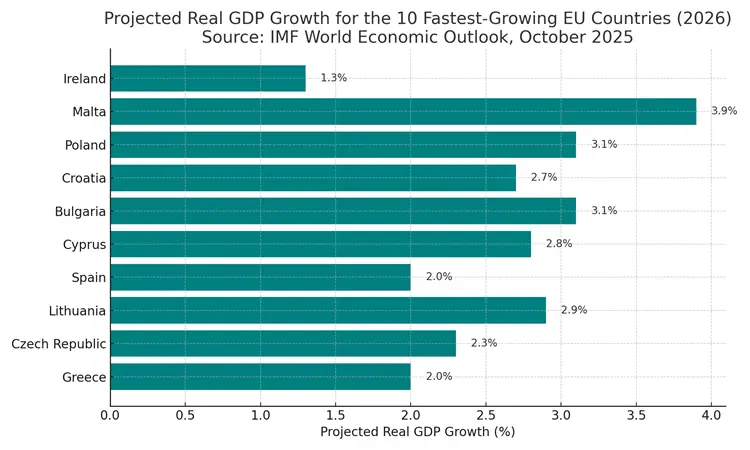
This change shows that economic opportunities are slowly moving east, where lower prices make it easier to buy things and encourage investment in the area. Overall, the Euro area economy is expected to grow at potential in 2026.
Ireland: The Best Performer
Ireland’s economy grew 16.2% year-on-year, which is a huge number compared to other European economies. The technology and pharmaceutical industries, as well as ongoing foreign direct investment from multinational corporations with their main offices in Dublin, have helped the country grow. Even though some of this growth is due to changes in global corporate taxes, Ireland’s strengths in software exports, biopharma, and renewable energy are still very clear. It ranks fourth in the list of the top 10 richest countries in Europe in 2025.
The Rise of Lithuania and the Baltics
Lithuania came in second with a growth rate of 3.0 percent. This shows that the Baltic economic model based on digital transformation, renewable energy, and manufacturing diversification is still working. Its capital, Vilnius, now has as many start-ups as cities in Western Europe, and the country’s ICT exports keep going up.
Spain and Portugal: The Return of Southern Europe
Spain came in third with a 2.8% growth rate, which was a strong recovery thanks to a boom in tourism and growth in the tech sector. Spanish cities like Malaga, Mallorca, and Tenerife have come back as lively service-based economies, taking advantage of trends in remote work and eco-friendly travel.
Portugal came in second with 1.9 percent growth, thanks to a strong renewable energy sector and a boom in real estate investment, especially in Lisbon and Porto.
Czechia: The Momentum of Central Europe
Czechia’s 2.4 percent growth rate shows how strong Central Europe’s industrial and technology corridor is. The country continues to benefit from near-shoring trends, which is when European manufacturers move production closer to home to make their supply chains less vulnerable.
Other fastest-growing EU economies
The Netherlands (1.5 percent), Belgium (1.0 percent), Sweden (0.9 percent), France (0.7 percent), and Estonia and Finland (0.5 percent) rounded out the top ten. Each of these countries saw small but steady growth despite problems in the global economy.
Wolfsburg, Braunschweig, and Leipzig, Germany’s industrial heartlands, used to be the backbone of Europe’s manufacturing strength. Now that the automotive sector has slowed down, these areas have stopped growing. The switch to electric cars and the realignment of global supply chains have hit car-producing areas the hardest.
Greece, on the other hand, has made an impressive comeback. Athens and Thessaloniki are now growing quickly after ten years of shrinking. This is thanks to investments in tourism, shipping, and technology. Greece is now one of Europe’s more flexible economies thanks to structural reforms, EU recovery funds, and a big rise in exports.
Cities That Are Driving the European Economy
The real story of growth is happening in the cities, not in the big national numbers. The most dynamic urban economies in Europe are those that combine sectors with high productivity and those that are driven by innovation.
Dublin and Valletta have been the fastest-growing city economies in Europe for the past 15 years, with annual growth rates of 6.0% and 5.7%, respectively. But the bigger picture shows a different story: Central and Eastern European cities are at the top of the growth leaderboard, with eight of the top ten spots.
Poland, in particular, stands out. Wrocław (5.2 percent growth), Gdańsk, and Poznań are now centres for advanced manufacturing, IT services, and logistics. Meanwhile, Iași in Romania and Vilnius in Lithuania round out the top five. This shows how well the region has been able to join the European digital and industrial supply chains.
What makes things grow: productivity or jobs?
European cities grow in two different ways: by increasing productivity or by creating jobs.
Central and Eastern Europe have a lot of productivity-led growth. This is because they adopt new technologies, become more efficient, and “catch up” to richer Western countries. Cities like Vilnius, Iași, and Wrocław are perfect examples of this trend, as they quickly close the gap in output per worker.
Growth driven by jobs, which is common in Western Europe, depends more on attracting workers and growing service industries. London, Amsterdam, and Luxembourg City are examples of this pattern. They grew by creating jobs and attracting people to live there, not just by becoming more productive.
Some smaller cities, like Cambridge, Bordeaux, and Nantes, have both strong labour market growth and lively start-up scenes.
What accounts for the difference?
There are three main reasons why some European economies are growing much faster than others:
Technological Leapfrogging: Central and Eastern Europe have quickly adopted digitalisation, automation, and green technologies, which has let them get around older industrial limits.
Policy Adaptability: Countries like Ireland, Lithuania, and Portugal have used flexible labour markets, tax breaks, and investment incentives to get global capital to flow into their economies.
Patterns of Migration and Demographics Because of labour mobility in the EU, remote work, and urban regeneration, talent has moved to mid-sized cities instead of traditional capitals.
The Future: Europe’s Growth Map After 2025
The growth landscape in Europe in 2025 is not set in stone. How well cities and countries use artificial intelligence, renewable energy, and changes in population will determine the next frontier.
Ireland and Lithuania seem to be ahead of the pack, but Spain’s digital and tourism boom and Poland’s industrial growth could change the order of Europe’s economies by 2030. At the same time, Western Europe’s economies that are growing more slowly have to stay competitive even though living costs are high and populations are getting older.
What is clear is that Europe’s future wealth will be written in its cities — in the tech corridors of Dublin and Vilnius, the logistics hubs of Wrocław and Gdańsk, and the reinvented waterfronts of Malaga and Thessaloniki. These cities make up the new power grid for European growth, which is the real engine room for the continent’s economic recovery.