Europe is a continent with a lot of different economies. It has some of the richest countries in the world as well as countries that have a lot of problems with poverty. The 10 poorest countries in Europe, which have a low GNI per capita, are mostly in Eastern Europe and the Western Balkans. These countries are going through a mix of changes since the fall of the Soviet Union, political instability, and problems with their economies and societies.
Exploring the 10 poorest European countries
Here is the list, with GNI per capita showing how much money each person makes in the poorest EU countries :
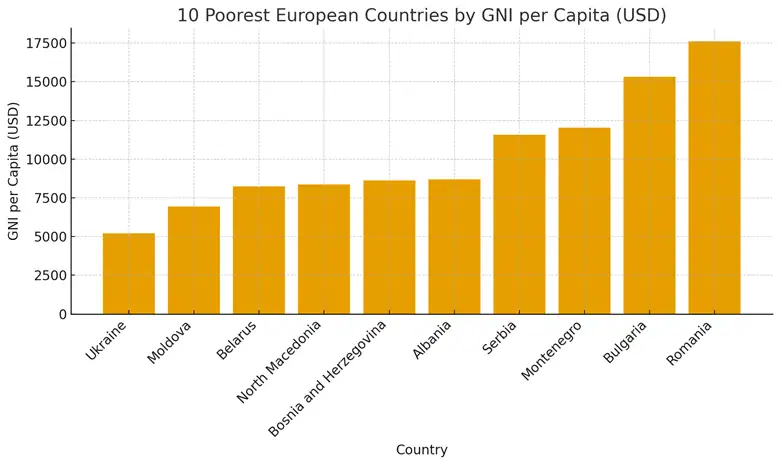
1. Ukraine: $5,220
2. Moldova: $6,940
3. Belarus: $8,240
4. North Macedonia: $8,360
5. Bosnia and Herzegovina: $8,630
6. Albania: $8,690
7. Serbia: $11,570
8. Montenegro: $12,020
9. Bulgaria: $15,320
10. Romania: $17,600
These numbers show how much poorer these countries are than the richest countries in Europe, like Luxembourg and Switzerland, where GNI per capita can be more than $100,000. The next parts look at the unique situations of each of these poor European countries.
Ukraine: The poorest country in Europe
Ukraine has the lowest GNI per capita in Europe. It has been badly hurt by political unrest and military conflict, including Russia’s annexation of Crimea in 2014 and the ongoing full-scale invasion since 2022. These crises have destroyed infrastructure, made it harder for people to find work, and made poverty worse. It has been hard for Ukraine to move away from the Soviet-era economy because of corruption and poor government. Many people are now living below the poverty line.
Moldova: Having a hard time
Moldova’s economy is still dealing with the effects of the Soviet Union’s fall. It has a GNI per capita of $6,940 and is dealing with problems like political instability, people leaving the country, and industries that aren’t fully developed. Reforms have helped lower the rate of poverty, but Moldova is still one of the poorest countries in Europe. It is still weak because it doesn’t get much investment, has trouble trading, and depends on farming.
Belarus: A Hard Change
The GNI per person in Belarus is $8,240. During the Soviet era, the country had a relatively high standard of living. However, since then, it has faced economic problems and international sanctions that have slowed growth. The economy of the country is controlled by the government, which makes it hard to make changes. Political repression has also hurt international relations and business opportunities.
North Macedonia: A Slow Recovery
Since becoming independent in 1991, North Macedonia’s economy has changed a lot. With a GNI per capita of about $8,360, it is still one of the poorest countries because of high unemployment (16.6%) and its dependence on trade. For progress to continue, there must be political stability and efforts to join European structures.
Bosnia and Herzegovina : Post-conflict reconstruction
The GNI per capita in Bosnia and Herzegovina is about $8,630. The country was at war in the 1990s. The legacy of the conflict includes broken government, ethnic divisions, and social inequality, with many households led by women having trouble making ends meet. Efforts to rebuild and bring people together are still going on, but poverty and unemployment are still big problems.
Albania
Albania is one of the poorer countries in Europe, with a GNI per capita of $8,690, but its economy is getting better. Albania uses its natural resources, like oil and minerals, after switching from a socialist to a market economy. But to really cut down on poverty, we still need to make structural changes, build up infrastructure, and lower unemployment.
Serbia: Economy getting better slowly
Serbia’s GNI per person is about $11,570. The global recession and political problems in the 2000s and 2010s stopped economic growth. The country has problems like public debt and poverty, which affects a quarter of the people. But areas like food production and energy are strong, which is helping the economy slowly get better.
Montenegro
Montenegro has a GNI per capita of $12,020 and relies heavily on tourism and energy. Even though it’s small, it has to deal with economic inequality, people who have to leave their homes, and a high poverty rate among groups that are already in trouble. Environmental damage and a lack of industrial diversity limit economic growth in general.
Bulgaria: Getting better but still poor
With a GNI per capita of about $15,320, Bulgaria has the weakest economy in the EU. But it has been growing steadily, and European integration and structural reforms have helped to lower poverty. The country has problems with low wages, a shrinking population, and differences between regions.
Romania: Moving up
Romania has the highest GNI per capita of the poorest countries on this list, at almost $12,600, but it still has a lot of problems to deal with. GDP and investment have gone up, but poverty is still high, especially in rural areas and among ethnic minorities. To catch up with Western Europe, we need to make changes to our infrastructure and government.
Problems that many of the poorest European countries have in common
The poorest countries in Europe face a number of problems:
- Historical legacies: Many people lived under Soviet rule for decades or were affected by the aftermath of wars.
- Political instability: Problems with politics both inside and outside the country hurt confidence in the economy and investment.
- High Unemployment: Many places have high unemployment rates, especially among young people.
- Limited Industrialisation: A few sectors or agriculture are very important to economies.
- Infrastructure Deficits: The infrastructure for transportation, education, and healthcare needs to be updated.
- Emigration: The brain drain and the movement of workers to other countries make the workforce less able to do its job.
Future Plans and Paths
Even though things are hard, there are signs of hope for these countries. Joining or becoming more involved with the European Union helps the economy and encourages reform. For growth to last, it will be important to invest in education, technology, and infrastructure, as well as stabilise the government. International cooperation and fighting corruption are still very important.
Final Thoughts
The poorest countries in Europe, mostly in Eastern Europe and the Balkans, have long-standing social and economic problems that are caused by history, war, and the difficulties of making changes. Their per capita incomes are lower than those of wealthier countries on the continent, but reform, economic diversification, and integration into broader European frameworks can help them get out of poverty. By learning about these countries’ specific situations, we can better understand the big economic differences in Europe and the need to keep supporting growth that includes everyone.