Imagine sitting in front of Elizabeth Bennet on your laptop screen, waiting for her to answer your questions about love, pride, and prejudice. What do you think she would say about marriage, being independent, or social media? Artificial intelligence has made it possible for people to have these kinds of conversations in real life. AI lets readers, writers, and teachers “interview” literary characters, which changes how we learn and teach literature.
From Reading to Talking
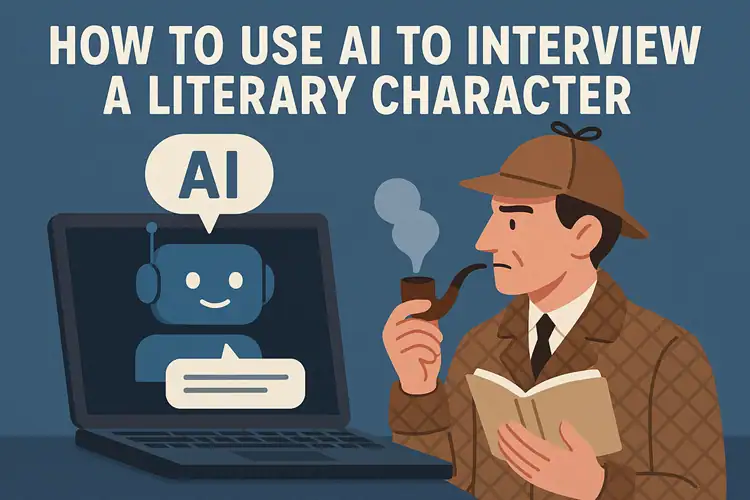
When you use AI to interview a literary character, you are asking the text to talk back. Readers can use a chatbot like ChatGPT to act out scenes with fictional characters like Hamlet, Raskolnikov, and Jane Eyre and learn about their thoughts, feelings, and decisions. The method changes passive reading into active dialogue: a performance where both the human and the machine read together.
The most important thing is not accuracy, but being real. The AI needs to sound like the character, talk like them, and stay true to the emotional logic of the text. When done thoughtfully, these kinds of conversations can help students understand more, feel more empathy, and read closely—all of which are skills that literature classes want to help students develop.
Step 1: Create the Persona
To begin, write a detailed character brief. Find important traits, ways of speaking, and defining events. For example, if you want to “interview” Jay Gatsby, pay attention to how charming he is, how nostalgic he is, and how he calls people “old sport” in a sad way. Then give the AI a command like this:
“You’re Jay Gatsby from The Great Gatsby.” You speak with grace and restraint, haunted by a lost love and sure you can change the past.
This gives the chatbot the right voice and tone before the questions start.
Step 2: Set the Stage
The mood is important for good interviews. You can put AI right into the prompt. Tell us when and where the conversation takes place:
“You are Elizabeth Bennet at Longbourn in 1812, and you just got a letter from Mr. Darcy.”
This bit of context makes the AI answer in a way that fits with the story’s mood and setting.
Step 3: Ask Questions That Make You Think
Stay away from trivia. Ask, “Do you think pride is worse than prejudice?” instead of “Where do you live?” The goal is to look into moral and psychological depth. These interpretive questions turn the exercise into real literary criticism by testing how characters think, doubt, or explain what they do.
Step 4: See how flexible your imagination is
AI lets characters go places that aren’t in their books. What would Antigone think about people breaking the law today? What would Okonkwo think of modern manhood? These meetings across time don’t take the place of the original work; they show how it deals with issues that are still important to people today.
A Useful Classroom Prompt: Interview a Literary Character
Teachers can make this activity more formal by giving students a structured prompt. This is helpful for literary analysis or discussion. You can copy, change, and paste the model below into ChatGPT or your favourite AI platform.
Prompt for Observation to Feedback
This prompt was only made for made-up literary characters. We suggest that teachers not use it with historical figures or characters linked to real-life events that involved trauma or marginalised groups, as AI roleplay can change how history and lived experiences are remembered.
In this role-playing activity, a student in [GRADE LEVEL / CONTENT AREA] talks to [CHARACTER NAME] after the events of [TITLE OF TEXT] by [AUTHOR NAME] to learn more about how the character feels, what they value, and why they make the choices they do.
You will be [CHARACTER NAME] and only speak in that character’s voice during the whole conversation. Answer like the character would, and use the text as much as you can. After the conversation, the student will decide if your answers match how the character is shown in the text. They will give examples and quotes to back up their analysis.
You should say hello to the student and tell them your name, which will make them want to ask you questions about what happened in the text. You shouldn’t ask the student any questions; you should only answer theirs.
Your answers should only be about what happened in the text or what can be reasonably guessed from it. Please don’t talk about things that aren’t related. The goal is for the student to learn more about the character so that they can connect what they learn to what they read later.
This is an example prompt.
This is a role-playing exercise in which a high school English student interviews Hamlet after the events of William Shakespeare’s play Hamlet to learn more about the character’s feelings, values, and decisions.
During the whole conversation, you will be Hamlet and only speak in his voice. Please answer in the style of Hamlet and use the play as much as you can. After the conversation, the student will decide if your answers are in line with how Hamlet is shown in the text. They will do this by giving specific examples and quotes that support their opinion.
Say hello to the student and tell them you’re Hamlet. This will make them want to ask you questions about what happens in the play. You shouldn’t ask the student any questions. You should only answer questions about what happens in the play or what can be reasonably inferred from it. Don’t answer questions that aren’t related to the topic.
More ways to prompt
To see if the roleplay worked, ask follow-up questions like, “Why did you wait to act?” or “Do you wish you hadn’t made those choices?”
Tell students to use direct quotes from the text to question what the AI says.
Compare how the chatbot sees the character with how the students or their peers see it.
Use chat transcripts as proof in essays or class discussions.
For a more in-depth look, try talking to more than one character from the same text.
If the first results aren’t what you wanted, try changing your input by adding more information, breaking down complicated requests into smaller steps, or telling the AI to ask questions to make things clearer before moving on. Always carefully check the AI’s answers to make sure they are in line with the spirit and morals of literary interpretation.
Conclusion: How to Use AI to Interview a Literary Character
Using AI to interview a literary character brings together the worlds of reading and acting. It’s not about letting machines rewrite literature; it’s about helping people read it more deeply. This method changes analysis into conversation when done with care. It’s a creative collaboration between text, technology, and the human curiosity that keeps stories alive.
The question isn’t if AI can be Hamlet, but if we can use it to better understand what it means to be human.